Blood pressure: the number most people miss
Three in four adults with a high reading in the national survey had not reported the condition. What the two numbers mean and how to measure them well.
Of the Australian adults whose blood pressure measured high in the 2022 National Health Survey, 74.5% had not reported having hypertension. About three in every four people with a high reading on the day, in other words, had not listed high blood pressure among their health conditions.
The Australian Bureau of Statistics (ABS), which ran the survey, counts a reading as high when the top number is 140 mmHg or more, the bottom number is 90 mmHg or more, or both. By that measure 23.3% of adults had high measured blood pressure in 2022, and the share climbs with every decade. Among people aged 45 to 54 it was 29.5% of men and 24.5% of women. At 65 to 74 it was 39.9% and 38.3%, and at 75 and over 42.3% and 44.0%.
The gap between measured and reported is widest in the younger groups. Among people aged 45 to 54 with a high reading, 81.1% had not reported hypertension. The figure was 75.2% at 55 to 64 and 63.6% at 65 to 74.
One survey reading is not a diagnosis. Blood pressure moves around during the day, and a GP will want more than a single measurement before drawing any conclusion. Still, a gap that wide suggests a great many people do not know their number.
Why it goes unnoticed
The Heart Foundation says there are no obvious signs or symptoms of high blood pressure, so a person may not know they have it.
The silence matters because of what sustained high pressure is linked to. The Heart Foundation calls it one of the main risk factors for heart disease, especially heart attacks and strokes. Healthdirect adds heart failure, chronic kidney disease and eye conditions that affect sight to the list of possible complications.
Very high blood pressure is a different matter. Healthdirect says it sometimes develops quickly, and it lists headaches, vomiting, confusion, seizures, problems with eyesight, chest pain and shortness of breath as symptoms that call for the nearest hospital emergency department or an ambulance on triple zero (000).
What the two numbers mean
A reading is written as two numbers, such as 120/80, in millimetres of mercury (mmHg). The top number is systolic pressure, the pressure in the arteries when the heart muscle contracts. The bottom number is diastolic pressure, taken when the heart muscle is between beats.
The Heart Foundation describes a systolic number under 120 with a diastolic number under 80 as a normal reading. Healthdirect says blood pressure is considered high when readings are consistently above 140/90 mmHg. The word "consistently" matters. The Heart Foundation explains that blood pressure is usually lowest during sleep and rises with excitement, stress or exercise, and that it can go up for a short time after caffeine or even while talking.
What a reading between the two thresholds means for one person is a question for their GP, who will set a target based on that person's medical history.
Getting a reading you can trust
In a clinic, an inflatable cuff goes around the upper arm and is connected to a measuring unit. Some people's readings rise in the doctor's surgery and are lower elsewhere, which Healthdirect calls white-coat hypertension. Partly for that reason, a doctor who records 140/90 mmHg or higher may ask a patient to check at home, or to wear a monitor for 24 hours. The Heart Foundation's page on 24-hour monitoring says the device takes a reading every 20 to 30 minutes, day and night.
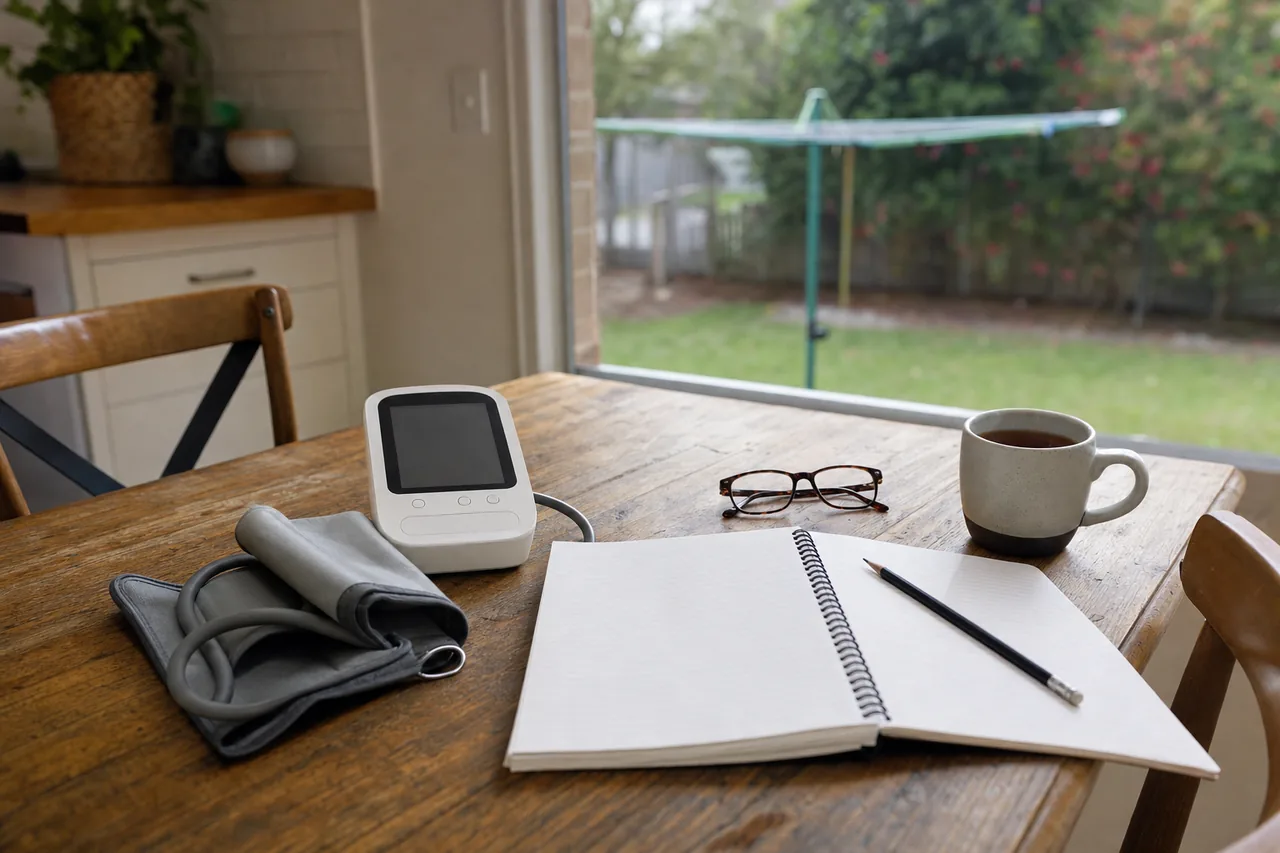
Home measurement is usually something a doctor asks for, the Heart Foundation says. Its instructions are specific.
- Use a cuff that fits the upper arm properly. The Heart Foundation's home measurement information sheet says finger and wrist devices are not recommended.
- Measure for seven days, five at a minimum, at about the same time each morning or evening.
- Take the reading before eating, taking medication or doing vigorous exercise, and leave 30 minutes after any caffeine or cigarette.
- Sit quietly for five minutes first, with both feet flat on the floor, legs uncrossed, the upper arm bare, and the back and arm supported.
- Take two measurements one minute apart and write both down.
- Skip the reading when you are uncomfortable, stressed or in pain.
The diary then goes to the next appointment. The Heart Foundation notes that a GP is unlikely to change treatment on the strength of a single reading, which is why a week of paired measurements is worth the trouble. It also points out that Australia has no registry of validated blood pressure monitors, and suggests having a GP or nurse show you how to use the device.
Salt, movement, alcohol and weight
The Heart Foundation says there is no one specific cause of high blood pressure. It lists several things that make it more likely: family history, eating patterns that include salty foods, alcohol, smoking, being overweight or obese, and how physically active a person is.
The Heart Foundation's page on salt and heart health recommends adults eat no more than 5 grams a day, which is about one teaspoon. It puts the average Australian intake at about 9 grams. The shaker on the table is not the main source. Around 75 to 80% of the sodium Australians eat comes from processed and packaged foods, so the nutrition panel is the place to look. Under 120 mg of sodium per 100 g counts as low. More than 400 mg per 100 g is high.
For physical activity, the Heart Foundation's advice is 30 minutes on most days of the week.
Alcohol acts on blood pressure in two ways. The Heart Foundation says a few drinks cause a temporary spike, and regular heavy drinking can lead to a long-term increase. For people who do drink, its page on heart disease risk factors gives the limit as no more than 10 standard drinks a week and no more than 4 on any one day.
On weight, Healthdirect includes losing weight, for people who are overweight, among the changes that help with blood pressure. It also says lifestyle changes are not always enough, and that some people need blood pressure medicines to bring their readings into the normal range. That is a decision made with a GP, and nothing here is a reason to start, stop or change a prescribed medicine.
When to have it checked
Both the Heart Foundation and Healthdirect say adults should have their blood pressure checked at least every two years. From 45, the Heart Foundation recommends it be done as part of a regular Heart Health Check with a GP.
At the appointment, ask for both numbers and write them down. Three in four people with a high reading in the ABS survey had not reported the condition, and a cuff around the arm is how any of them would find out.
Sources
- Australian Bureau of Statistics, Hypertension and high measured blood pressure, 2022.
- Heart Foundation, Blood pressure and heart health.
- Heart Foundation, Measuring your blood pressure at home (information sheet, PDF).
- Heart Foundation, 24-hour blood pressure monitoring.
- Healthdirect, High blood pressure (hypertension).
- Heart Foundation, Salt and heart health.
- Heart Foundation, Are you at risk of heart disease?.