Osteoarthritis is not just wear and tear: why movement helps
Australian guidelines put exercise and weight management ahead of scans and surgery for sore knees and hips. Here is the reasoning.
For decades osteoarthritis was explained as “wear and tear”, as if a knee or hip were a tyre losing its tread. The picture is easy to grasp, and it is misleading. Arthritis Australia now describes osteoarthritis as a condition of the whole joint, involving bone, cartilage, ligaments and muscles, and says it is thought to come from a joint working extra hard to repair itself. The Royal Australian College of General Practitioners (RACGP) goes a step further. Its guideline for knee and hip osteoarthritis asks GPs to avoid the terms “wear and tear” and “bone-on-bone” altogether, because they can leave people believing that nothing can be done and that exercise is harmful.
That belief has consequences. The treatment Australian guidelines rank highest is the one a worn-out-tyre image talks people out of, which is regular exercise.
What is going on inside the joint
Arthritis Australia lists several changes that can occur together. The tissue around the joint becomes inflamed. Cartilage, the cushion on the ends of the bones, is damaged. Bony spurs grow around the joint’s edge, and the ligaments and tendons can deteriorate. Knees, hips, finger joints and the big toe are affected most often. Pain and stiffness tend to arrive slowly, over months or years.
Healthdirect says the exact cause is not known. Risk rises with age and is higher in women, in people with a family history, in people living with overweight, after a joint injury such as a dislocation, and in those whose work involves heavy lifting or manual labour. Victoria’s Better Health Channel makes the point that it is not simply a disease of ageing.
How common it is
The Australian Bureau of Statistics found in its 2022 National Health Survey that just under 3.7 million Australians, or 14.5%, had arthritis of some kind. Osteoarthritis was the most common type, reported by 57.0% of people with arthritis.
The figures climb steeply from midlife. Among 45 to 54 year olds, 14.9% of men and 17.9% of women had arthritis. In the 55 to 64 group it was 25.9% of men and 35.5% of women. By 65 to 74 the proportions were 33.8% and 49.1%, and at 75 and over they reached 41.1% and 55.4%. These numbers cover all forms of arthritis, not osteoarthritis alone.
Why an X-ray says less than you might expect
If osteoarthritis really were mechanical wear, a picture of the joint should predict how much it hurts. It does not. Arthritis Australia notes that an X-ray showing joint damage does not always mean a person will have a lot of pain, and that a joint can be very painful while its X-ray looks normal.
For that reason the RACGP guideline treats osteoarthritis as something a doctor diagnoses from the history and a physical examination. Imaging is kept for cases where the symptoms are unusual or another condition is suspected.
Why exercise comes first
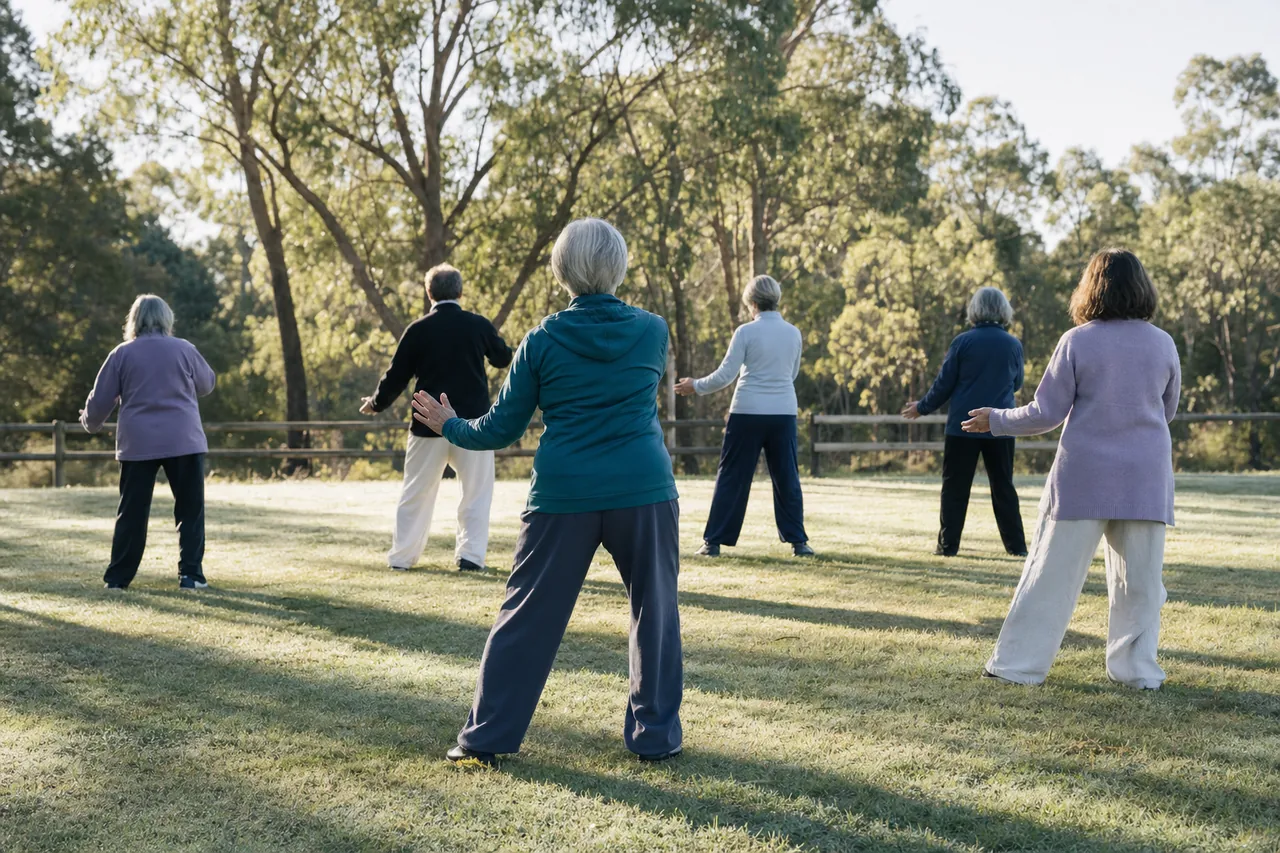
The RACGP’s strong recommendations begin with land-based exercise. It should be offered to everyone with knee osteoarthritis to improve pain and function, regardless of their age, pain levels or how advanced the joint changes are. For the knee, the guideline names walking, muscle-strengthening exercise and tai chi. For the hip it also strongly recommends land-based exercise, while admitting that the most helpful type is not yet known.
The college’s plain-language summary adds that stationary cycling and Hatha yoga could be considered for some people with knee osteoarthritis, and exercise in water for some people with knee or hip osteoarthritis.
Two caveats are worth knowing. The guideline rates the quality of the research behind these recommendations as low or very low for the knee and moderate for the hip, even though it backs exercise at its strongest level. It was also published in 2018 and is currently being updated, so details may change.
As for how exercise helps, Healthdirect explains that it keeps joints and muscles healthy and flexible and can reduce pain. Strengthening work with weights or resistance bands builds the muscles around a joint, which takes pressure off it and improves balance. Brisk walking, swimming or cycling build general fitness. Healthdirect suggests choosing low-impact activities that you enjoy and that are convenient to do.
Where weight comes in
Weight management is the guideline’s other strong recommendation. For people with knee or hip osteoarthritis who are overweight or obese, the RACGP sets a minimum target of losing 5 to 7.5% of body weight, and notes that larger losses bring more relief. For someone who weighs 90 kg, that minimum works out to roughly 4.5 to 7 kg. The guideline advises combining weight loss with exercise for greater benefit.
Healthdirect gives the reason: extra body weight increases stress on many joints, especially the knees, hips and lower back.
What a GP or physio can offer
A GP is the starting point. Many different conditions cause joint pain, and they need different treatment, so a proper assessment comes before any plan. Healthdirect advises seeing a doctor if joint pain, trouble walking, reduced mobility or grinding in a joint affects daily life or lasts more than a few days.
From there, the Better Health Channel says a physiotherapist or exercise physiologist can design an individual exercise program, starting with what is achievable and building up slowly. If an exercise feels uncomfortable, it advises raising it with the professional managing the program, who can check that it is being done properly and still suits you.
Healthdirect also lists dietitians, psychologists and occupational therapists among the professionals who work with osteoarthritis. Pain-relief medicines, including anti-inflammatory medicines, have a place for some people. They carry side effects and are aimed at easing symptoms, so the choice is one to make with a GP or pharmacist.
Surgery sits at the far end of the path. The Better Health Channel says most people with osteoarthritis will not need it. Arthritis Australia describes joint replacement as an option usually considered only when weight loss, exercise and medicines have failed to control symptoms.
A long-term condition, managed well
There is currently no cure for osteoarthritis, and Arthritis Australia advises caution about any product or therapy that claims to be one. The same organisation also says the outlook for most people is very positive, and that for many the condition stays mild. What the guidelines ask for is simple enough. Keep the joint moving and build the muscles around it, with a GP or physiotherapist setting the program to suit your own knees or hips.
Sources
- Arthritis Australia, Osteoarthritis.
- Royal Australian College of General Practitioners, Guideline for the management of knee and hip osteoarthritis (2nd edition): Background.
- Royal Australian College of General Practitioners, Guideline for the management of knee and hip osteoarthritis: Strong recommendations for the intervention.
- Royal Australian College of General Practitioners, Guideline for the management of knee and hip osteoarthritis: Summary, plain language.
- Healthdirect Australia, Osteoarthritis (OA): symptoms, treatments and diagnosis.
- Better Health Channel (Victorian Department of Health), Osteoarthritis.
- Australian Bureau of Statistics, Arthritis, 2022.